Proof / proof permission
Ask for a Client Testimonial
Use an optional request, neutral questions and an approval record that connects the source response to the exact quote and its permitted use.

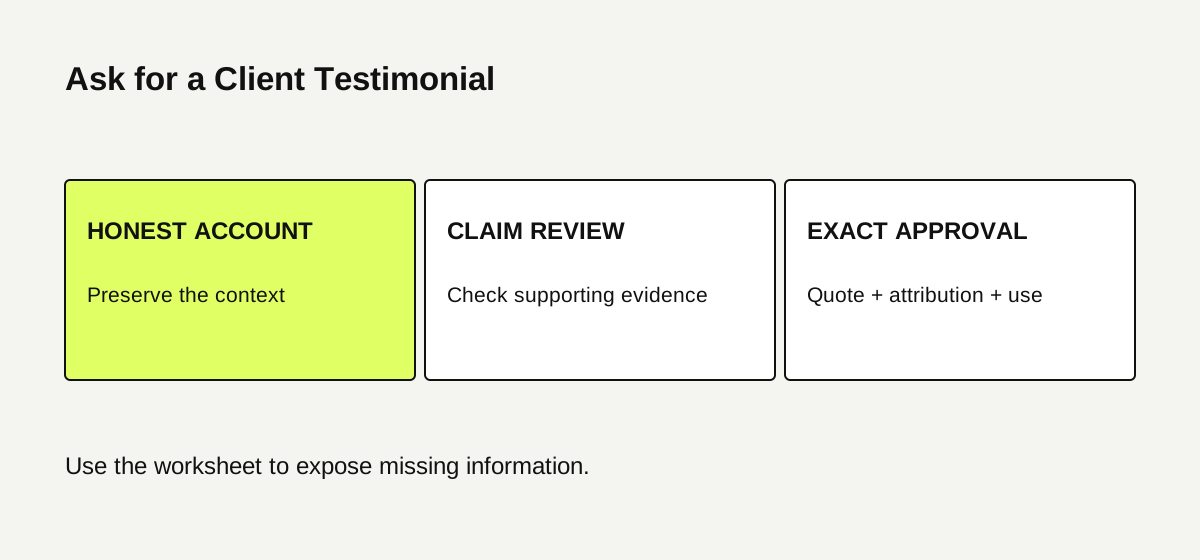
Ask a client for an honest account of a specific piece of work, then obtain approval for the exact quotation, attribution and publication channels you intend to use. Treat private feedback and permission to publish as separate decisions.
This guide provides original request wording, interview prompts and a testimonial approval record. The blank record connects the source response to the final excerpt and its approved use. It is an editorial workflow, not a legal release or a guarantee of compliance.
Choose a piece of work the client can discuss
Name the project, service or completed milestone. The client needs enough experience to comment on it. Avoid writing the result into the request before they have described it themselves.
Tell the client what you would like to do with their words. Give them a comfortable way to decline or provide feedback privately. A support message, positive email or public review should not silently become permission to use a person's name, company logo or photograph in a new advertisement.
Send a short, optional request
Subject: A comment about [project or service]
Hi [name],
Would you be comfortable sharing a short account of [specific work] now that you have had a chance to use it?
It would help to hear what you needed, what you experienced and anything a similar client should understand. An honest limitation is useful too.
We would like to consider an excerpt for [named page or channel]. I would send the exact wording and attribution for your approval before publishing. You are welcome to decline or keep your feedback private.
[Sender]
Replace the fields with accurate details. Do not promise that feedback will stay private if you cannot honor that choice under the actual collection process. If the client declines, record that response and stop treating the request as an unfinished marketing task.
Ask questions that preserve context
Choose a few relevant questions rather than sending an interrogation. These prompts are original examples; they do not assume a positive outcome or ask the client to endorse a claim you have already written.
| Prompt | Context to preserve |
|---|---|
| What work were you trying to complete? | The task and starting situation |
| Which part of the service did you actually use? | The scope of the experience |
| What changed, if anything, while using it? | The client's account, including no change |
| What remained difficult or needed other work? | Limits and other contributing factors |
| What should a similar client check before choosing it? | Conditions relevant to another reader |
If a number is offered, ask what it measures, which dates it covers and what supports it. Keep it unverified until the appropriate evidence has been checked. Do not convert a client's recollection into an independently measured result.
Review the claim before editing the quote
The FTC's endorsement guides (16 CFR Part 255) explains that endorsements must be honest and not misleading. It also addresses unexpected material connections and claims that imply typical results. A general “results may vary” line does not resolve every unsupported implication.
Have the appropriate reviewer examine a performance claim or material connection before publication. The client's approval of the quotation does not by itself establish the evidence for an advertising claim. This article does not supply a universal disclosure or legal conclusion.
Obtain approval for the actual excerpt
Send the final proposed wording with the intended name, role, company reference, image or logo and each proposed channel. Include the context that will appear around the quote. An excerpt can become misleading even when its individual words came from a real response.
Use the worksheet to record the source response, excerpt version, claim review, attribution, permitted channels and approval reference. Mark an unanswered request as pending. If editing changes the meaning or the proposed use changes, obtain the appropriate fresh approval before using it.
Keep a review and correction route
After publication, keep the live URL with the approval record. Assign someone to handle a correction or removal request and to review whether the quote still describes the relevant service version. Follow actual agreements and applicable requirements when responding.
For placement, continue to putting context before a testimonial. For evaluating weak proof, read why testimonials do not automatically create trust. Sources checked 15 October 2026. W Effect Blog has not tested these messages for response or conversion outcomes.
Read next
Related trust repairs.

Why Testimonials Do Not Automatically Create Trust
How to tell whether a testimonial is reducing real risk or simply making the page look busy.
How to Use Customer Logos Without Looking Like a Status Wall
A guide to using customer logos as evidence of fit, not as a trophy strip.
The Case Study Shape That Makes Proof Easier to Believe
A practical structure for turning customer stories into proof that does not feel inflated.

When Numbers Help and When They Make a Page Feel Fake
How to use metrics, counts, percentages, and timeframes without creating a credibility problem.